UK employers face record penalties. Is your business protected?
Clara Benson
•
27 May 2026
•

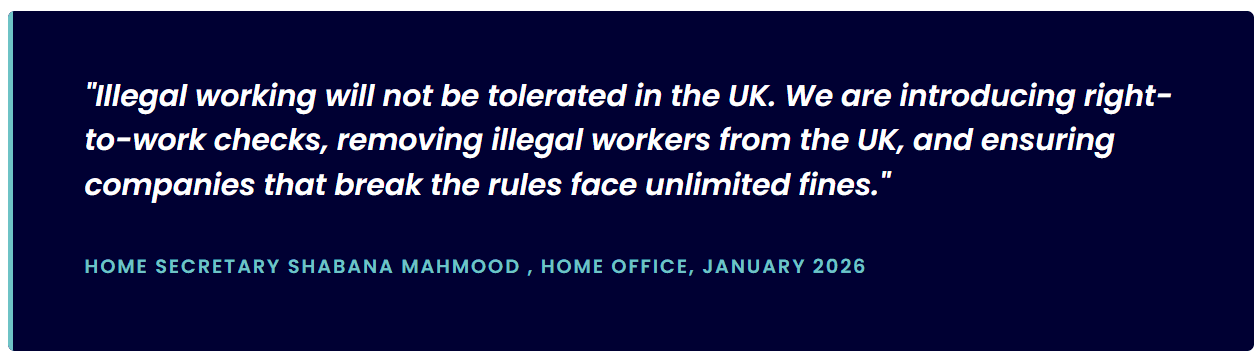
The UK government's crackdown on illegal working has reached its highest level on record. High street businesses, hospitality operators, and staffing agencies are all in the crosshairs . The financial consequences of getting it wrong have never been higher.
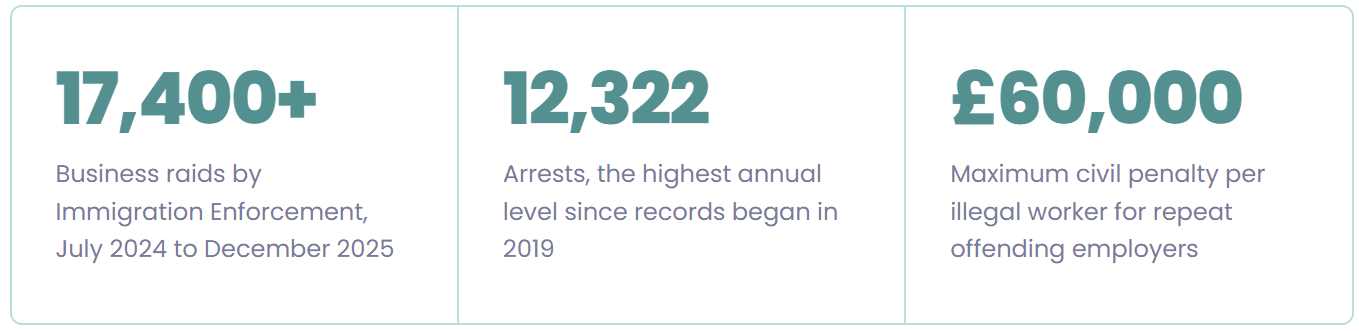
You've seen the footage. Officers in hi-vis jackets, businesses cordoned off, workers detained outside a nail bar in Peckham or a barber shop in Walthamstow. It can feel like something that happens to other industries, other types of business. It doesn't. Enforcement visits to UK businesses rose 77% in the 18 months to December 2025, and the Home Office has made clear that every sector relying on flexible, casual, or temporary workers is a target.
That means hospitality. Retail. Recruitment. Construction. Delivery. If you employ people, especially if you hire flexibly, you are in scope. The question is not whether enforcement will intensify further. It will. The question is whether your compliance records will protect you when it does.
Sources: Home Office press release, January 2026; Recruiter.co.uk, January 2026
What Changed and Why the Old Approach No Longer Works
Right to Work checks have been a legal requirement since 2006. For most of that time, enforcement was sporadic enough that many businesses, particularly smaller ones, treated them as a formality, or skipped them altogether. That calculation has fundamentally changed.
In February 2024, the Home Office tripled the civil penalty ceiling. The new Border Security, Asylum and Immigration Act is now extending Right to Work obligations beyond traditional employment into the gig, casual, subcontracted, and temporary worker economy. These are precisely the sectors where smaller businesses and staffing agencies depend most. That expanded regime is expected to take full legal effect from 1 October 2026.
The operational picture reinforces the rhetoric. More than 17,400 business visits were made to nail bars, car washes, barbers, takeaways, and convenience stores in 18 months. These are sectors where informal hiring has long been commonplace. Arrests rose 83% year-on-year. This is not a campaign. It is a permanent structural shift in how the UK government enforces employer compliance.
The Two Checks That Can Expose Your Business
01 Right to Work
Under Section 15 of the Immigration, Asylum and Nationality Act 2006, every employer in the UK, regardless of size, must check that every employee has the right to work before their first day. There are no exemptions for small businesses, no grace periods, and no defence of not knowing.
The law provides one meaningful protection: a statutory excuse. If you can produce a correctly completed Right to Work check, you are protected from civil liability even if a worker later turns out to be working illegally. If you cannot, you are liable, regardless of whether the breach was intentional.
02 DVLA Driving Licence Checks
Any employee who drives on company business, whether a delivery operative, a field technician, a sales representative, or a manager using a pool car, creates a legal duty of care for your business. You are required to verify that they hold a valid, appropriate licence before they drive.
The critical compliance risk here is invisible by design. Employees are under no legal obligation to tell you when they accumulate penalty points, receive endorsements, or are disqualified. The driver you sent out this morning might already be disqualified. Without a systematic check, you would not know until something went wrong.
October 2026: The Rules Are About to Expand Further
The Border Security, Asylum and Immigration Act is introducing one of the most significant changes to employer compliance obligations since 2006. From October 2026, Right to Work checks will formally extend to workers engaged through online matching platforms, gig platforms, and subcontracting arrangements, closing what the government has described as the last hiding places in the casual economy.
For businesses in hospitality, construction, events, logistics, or any sector that flexes its workforce around demand, the window to build a compliant process is narrowing. The informal practices that were tolerated for the last decade are becoming structurally illegal. The businesses best placed to weather the next phase of enforcement are the ones building auditable compliance systems now.
Don't wait for a knock on the door.
See how Xertilox makes Right to Work and DVLA driving licence checks instant, digital, and fully auditable. Book a 20-minute demo.
Book a Free Demo No commitment. No long contracts. Operational in days, not months.